
When History Was Silenced
A tale of two exhibitions

History has, of course, always been political. But even in this age of extremes, it is shocking that a talk that was meant to take place at the British Museum today about Ancient Israel and Judah as part of Jewish cultural month has had to be ‘postponed’ because, the Museum says, of ‘security reasons’.
A few months ago, I went with my Christian friend Mark to see some of those historical artefacts – I think I rather disappointed him with my lack of knowledge about the Tanakh (Old Testament). He wanted to show me the evidence for some of the stories in the bible – to explain that while, yes, there are some tales that could be seen as parables or legends, it is also a book of history.
This is what’s controversial. The first artefact showing an Israelite King is nearly 3000 years old; the Black Obelisk of Shalmaneser III shows Jehu, King of the Israelites, prostrating himself in front of the Assyrian King. The Museum also holds a replica of the Tel Dan Stele, which is even older. The stone, which dates back to the 9th century BCE features the earliest known extra-biblical reference to the House of David.
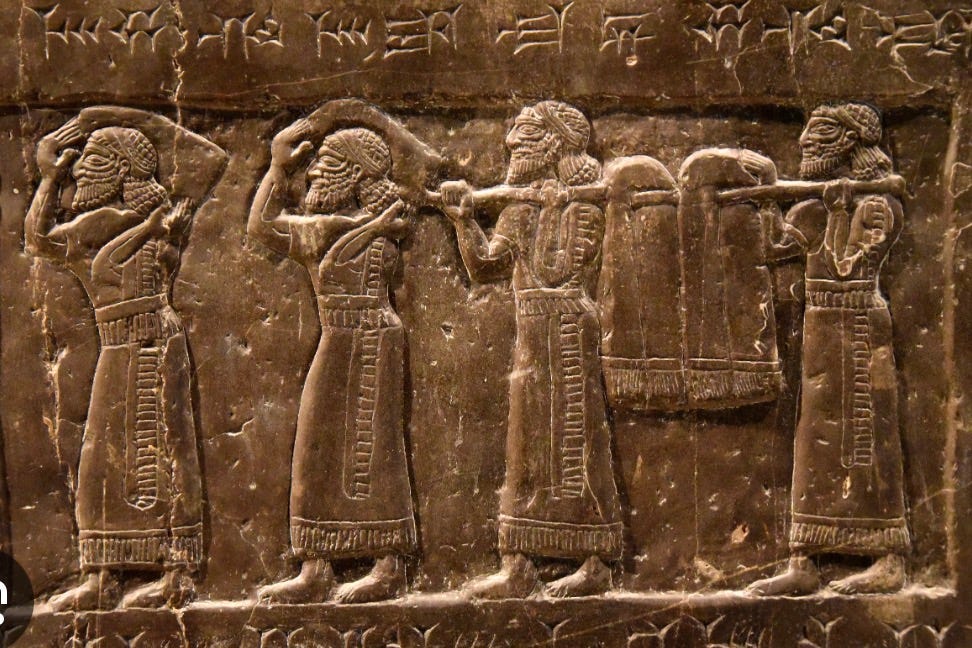
The Black Obelisk
The Taylor Prism, which records the military campaigns of Assyrian King Sennacherib detailing his invasion of Judah, matching the narrative in 2 Kings, is from 700 BCE. The Cyrus Cylinder, one of the most famous pieces in the Museum, dates back more than 2500 years and documents the decree when the Persian King allowed the Jews back into Jerusalem after their Babylonian exile. I could go on.
History has been political at the British Museum throughout its existence. The Elgin Marbles, stripped from the Parthenon in Athens, are a long-standing issue between the UK and Greece. It is home to plundered booty from around the world, thanks to British colonialism, and a genuine love of science and beauty. We saved treasures and we kept them.
When Mark and I visited the British Museum, most of the galleries housing stuff from the Ancient Levant were closed. A bit of begging got us in. The galleries were in the midst of change.
It appears the name Palestine had been applied anachronistically to pre-Roman period Israel – the area was only given that name in 135 CE following the Roman expulsion of the Jews. After complaints and a strongly worded letter from the UK Lawyers for Israel, who argued that modern political identity had been projected onto ancient history, the Museum concurred.
Facts, actual history, have angered some of those who seek to deny Jews have any history in Israel. It’s weird to me that anyone from Christian countries, where the birth of a Jewish boy born in Bethlehem and who preached in Jerusalem, should try to erase the history of Judaism in that land. But here we are: it is no coincidence that there are those – even a few, shockingly, in the church – who pretend Jesus, ‘the King of the Jews’, was Palestinian.
When it became known that the Museum was changing the labels, there was a fierce row led by antizionist historian William Dalrymple. A petition and open letter, signed by thousands, accused the museum of ‘rewriting history’. There were protests outside the Museum.
That’s the history to this story of why a Museum may need to postpone a talk for ‘security reasons’. But perhaps there is more still: when Mark and I went to the British Museum there were gates, security guards, a metal detector and bag search. If the Museum needed extra police on hand to guard some of the most valuable treasures in the world, it’s likely they could have had them.
Last night, the Museum said it had postponed the talk after learning that some protesters had legally purchased tickets and were planning to attend the event to disrupt. They still won. The silencing of the talk still happened.
Jewish history was silenced just as my comedienne friend Rachel Creeger was cancelled from her Edinburgh Fringe event last year for ‘security reasons’ cited by staff who didn’t feel safe in the proximity of a Jew. Other comics, musicians, have been similarly cancelled since October 7 took the lid off the polite antisemitism and it went rabid.
We as a country have to get better at facing down bullies. Otherwise, I fear, we will normalise this silencing.
Meanwhile, another exhibition went ahead, even though, at first the police had asked for its sign to be removed.
The Nova exhibition, titled ’06.29am – the moment music stood still’ is on in East London until early July. I implore you to go.
While I’ve been to the real Nova site several times, and have interviewed many survivors, the exhibition brings the horror alive but is not gratuitous.
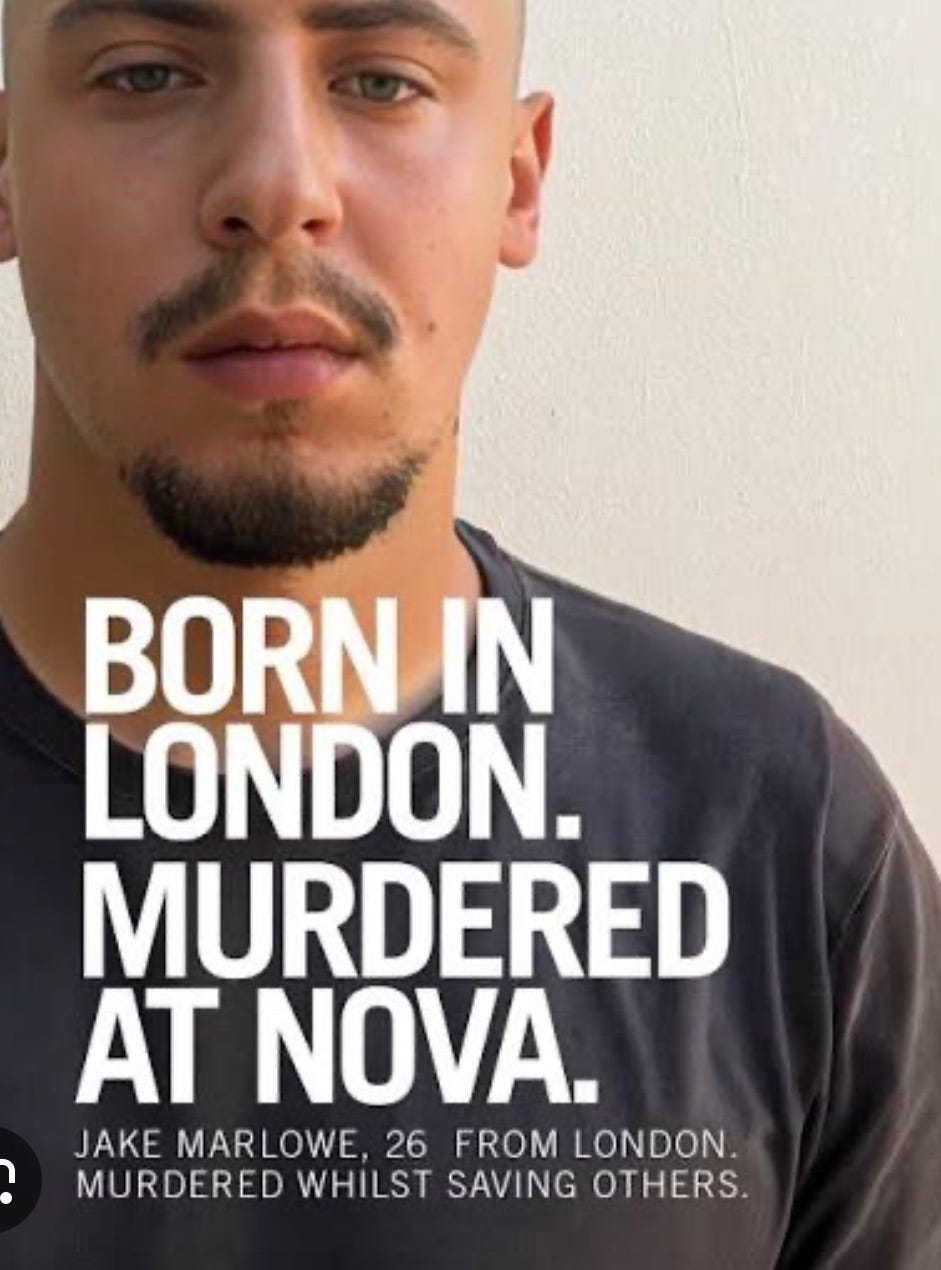
Shortly before the exhibition opened, I interviewed the lovely Michael Marlowe about his son Jake, who was killed at Nova, for the Telegraph - I publish a version of the piece below. Jake was a British Jew who left the UK because of antisemitism, only to find it in Israel, in a different way.
Jake’s lovely mum Lisa will be at the Nova Festival exhibition for most of its run. She feels like she is with Jake there. If you see her, give her a hug.
(Other work I’ve done recently: a story about antizionism in a teaching union here and an opinion column about the protests here.)
Why I Am Fed Up With Hollow Words
Michael Marlowe’s son Jake was killed by Hamas terrorists October 7, one of 18 Brits killed that day. He was working as a security guard at the Nova festival and stayed to shepherd people to safety. Here, his father Michael, 64, reveals what it has been like to see the horrific rise in antisemitism in the UK in the wake of those attacks, and why his 26-year-old son Jake was a visionary.
‘I call them hate marches because they are. My son, Jake Marlowe, was born and raised in London but on October 8, even as the scale of the Hamas massacre was becoming clear, there were people celebrating his murderers on the streets he once walked.
I have avoided going into Central London every time there are demonstrations: I cannot bear to see them and what they stand for. But I was at a vigil in Brighton for the Israeli hostages when a march ‘for Palestine’ went past us – they deliberately started close to where we met – and they screamed that we were baby killers. I dropped my poster of Jake and had to be held back. They are supporting the killers of my boy, my son, my future.
Jake saw the writing on the wall when he decided to leave the UK for Israel in 2021, when he was 24. He was a talented musician, touring the world as a bass guitarist with the band Desolated. They played to thousands of people. But in 2021, he sensed antisemitism was rising and that it was going to get worse.
It was seeing a video of some heinous scum, who had driven to London from Bradford, where, for more than two hours, they drove around Jewish areas with their megaphones blaring out that they wanted to rape Jewish women, and the fact that the police didn’t stop them, that really shook him.
Within two months, he had decided to make Aliyah (move to Israel). He was someone who had never even dated a Jewish girl, but he saw the way things were going. He said, ‘It doesn’t feel safe in this country for us.’ He was a visionary; he sensed something I hadn’t yet felt.
Jake fell in love with Israel and worked harder than ever before, as a carpenter, an odd-job man. There was good money for security guards, who were unarmed, for four days work. We later learned he planned to use the money he earned at Nova to take his girlfriend to Jerusalem and propose to her.
On October 7, Jake called us at 6.29am local time, 4.29am here at home, just to say, ‘There’s a lot of commotion, I will call you back later.’ That call never came.
What we learned later was that Jake had helped shepherd hundreds of people to safety as Hamas attacked the unarmed people at the rave. He was a hero. His body was identified through DNA.
I had taken the first flight to Israel I could get, and when I arrived, I was initially told by the British consulate in Tel Aviv they believed he had been taken hostage. But then, just a few hours later, I was invited to identify his body. I called my wife Lisa, who had to stay at home with our daughter, who has special needs. The sound of her crying is one I will take to my grave.
I recognised Jake’s boots first. Then his tattoos. He had been shot nine times. I insisted on his face being uncovered so I could kiss him goodbye. I know this sounds dramatic, but it is a vision that has kept me up at night ever since.
For a long time, we were paralysed with grief. But one Friday morning we were invited to address a small Jewish group that met every Friday morning at the end of a car park in Borehamwood. We spoke about Jake and his friend Shlomi, who was still being held hostage. That group, which met every Friday morning, became a family and a form of therapy for us. I started a tradition of buying a coffee for every speaker; many of them were family members of hostages.
I hug people, I hug everyone. People say, ‘we have no words for you’ because there are no words. Lisa and I have become very good actors. We smile, we hug, we talk about Jake as much as we can. But we are different people. We don’t sleep. We see our friends’ kids moving on, getting married, having children, and we know we will never have that. Our future has been taken from us. We are broken.
We focus our energy on making sure Jake’s memory is used for good; he has ambulances dedicated in his name and we have set up the JakeyM Project to encourage people to do good deeds for charity. We have been inundated with love. And we fight the antisemitism Jake first recognised.
I was in Golders Green shortly after the attacks on two men last month. This felt very close to home; our daughter Natasha volunteers in a shop just a few doors down from where one of the men was stabbed. If she’d been outside – could she have been hurt?
When Keir Starmer came, there was anger that he hadn’t even stopped to talk to people there. He showed his true colours. Jewish people do our best to fit in; we are law-abiding, model citizens. But we are not being protected.
Starmer has blood on his hands. Antisemitism has been allowed to run riot. I am fed up with his hollow words.
I’m not sure whether it’s too late for this country. It might sound strange, but Lisa and I feel safer in Israel. We have been there 15 times since Jake was killed. While we buried him here, his heart and soul were in Israel, and we feel closer to him there. But moving to a different country isn’t easy: our daughter is settled here. We don’t speak the language. It’s expensive to live there.
But I think that more and more British Jews will move to Israel because, like me, they don’t see any light at the end of the long tunnel here. The hate is relentless and things are getting worse and worse. People shouted at Starmer, which is not something Jews usually do, but the situation is too grave for silence. And so I use my small voice to speak. I will not be silent.’
For more about the exhibition, see here
https://novaexhibition.com/london-exhibition